Short version: most Metairie and Kenner yards flood because the lot is close to flat, the clay soil drains slowly and the downspouts dump roof water right at the slab. If water is still sitting 24 to 48 hours after the rain stops, the yard has a drainage problem. HomeAdvisor's national averages put a full yard drainage system at about $4,620, with most jobs between $2,145 and $7,162.
New Orleans gets about 62.7 inches of precipitation a year, the most of any major US city, according to NOAA data for 1981 to 2010 published by Statista. Metairie and Kenner sit right next door and take the same storms, often 2 or 3 inches in a single afternoon. A yard that cannot shed that much water becomes a pond, and the pond usually forms against the house.
This guide explains why Jefferson Parish yards hold water, how long a puddle can sit before it counts as a problem, and what each fix does and costs. We are CMC's Services, an outdoor contractor at 5245 York St in Metairie, and we have built drainage, leveling and hardscape projects across the parish for more than 10 years. The cost figures come from national guides, because your own price depends on the lot, the length of pipe and where the water is allowed to go.
Our view, stated up front: most standing water around here is a grading problem first and a pipe problem second. A French drain in a yard that slopes toward the slab only catches part of the water. Fix the slope, then add pipe where the slope alone cannot do the job.
Why does water pool in Metairie and Kenner yards?
Water pools here because most lots have almost no natural fall, the soil under the sod is dense clay that takes in rain slowly, and the ground stays saturated from a high water table. Add roof runoff from the downspouts and a neighbor's raised yard, and a 20 by 30 foot backyard can collect hundreds of gallons in one storm.
Start with the flat lots and slow soil. Much of East Jefferson sits at or below sea level, and the parish pumps storm water out through canals and pump stations. Within a single lot, the difference in height between the back fence and the slab is often only a few inches. Water needs about 2% slope, roughly a quarter inch per foot, to move across a lawn, and many older Metairie yards do not have it. Clay makes it worse. Sandy soil lets rain soak in quickly, but the heavy clay under most local lawns can still be holding last night's rain at breakfast.
Settling ground is the next cause. Houses on pilings stay put while the yard around them sinks, so after 15 or 20 years the grade often tilts back toward the house. You see it as a gap under the slab edge, flower beds that sit lower every year, or a patio that now drains the wrong way.
A high water table adds to it. After a wet week, the soil a foot or two down is already full, so new rain has nowhere to go but the surface. That is why the same yard can drain fine in October and flood in June.
Then there is roof water and the neighbors. A 2,000 square foot roof sheds about 1,250 gallons in a 1 inch rain, and most of that leaves through four or five downspouts. If those downspouts end at the slab, the wettest strip of your yard is the one right against the house. Two other causes we run into often are a neighbor who raised their yard with fill dirt so the runoff now crosses the property line, and a yard catch basin packed with leaves, sand or mulch so it no longer takes water.
How long should standing water last after a storm?
A puddle that is gone within a few hours after the rain stops is normal on a flat lot. Water still sitting 24 hours later in summer, or 48 hours later in cooler months, means the yard is not draining. Standing water that lasts for days kills St. Augustine grass in patches and gives mosquitoes a place to breed.
What are the signs a drainage problem is reaching the slab?
Water is reaching the foundation when you see soil washing out from under the slab edge, a dark wet line along the bottom row of brick or siding, mildew on baseboards near outside walls, or doors on that side of the house that begin to stick. Any one of these means water has been sitting at the slab for a while.
After a heavy rain, look for mud splashed 12 inches up the wall, and compare the soil at the slab with the lawn 6 feet out. If the soil next to the house sits lower, the yard drains toward you.
If you already have cracks in interior walls or tile, have a foundation company look at the slab as well. Yard work stops new water from collecting, but it will not close an existing crack.
Which drainage fix works best in a Jefferson Parish yard?
The right fix depends on where the water comes from. Regrading fixes a yard that slopes the wrong way. A French drain fixes a long wet strip. A catch basin fixes one low spot. Burying the downspouts fixes roof water at the slab. Most Metairie yards need two of these together, usually leveling plus a buried downspout line or a catch basin.
Regrading and leveling reshape the yard so it falls away from the house, at least 6 inches over the first 10 feet next to the slab. On a small lot that can mean adding fill along the foundation and cutting a shallow swale along the fence line to carry water to the front. It is the fix we start with, because it moves surface water without any pipe that can clog. Our yard leveling service in Metairie covers this work.
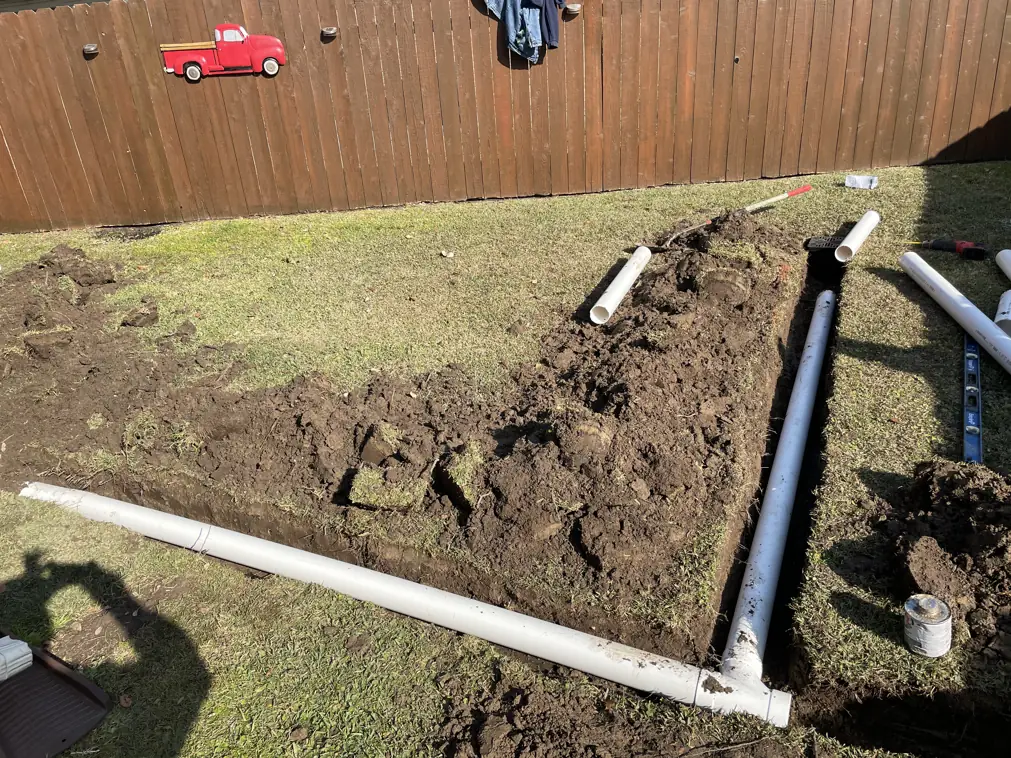
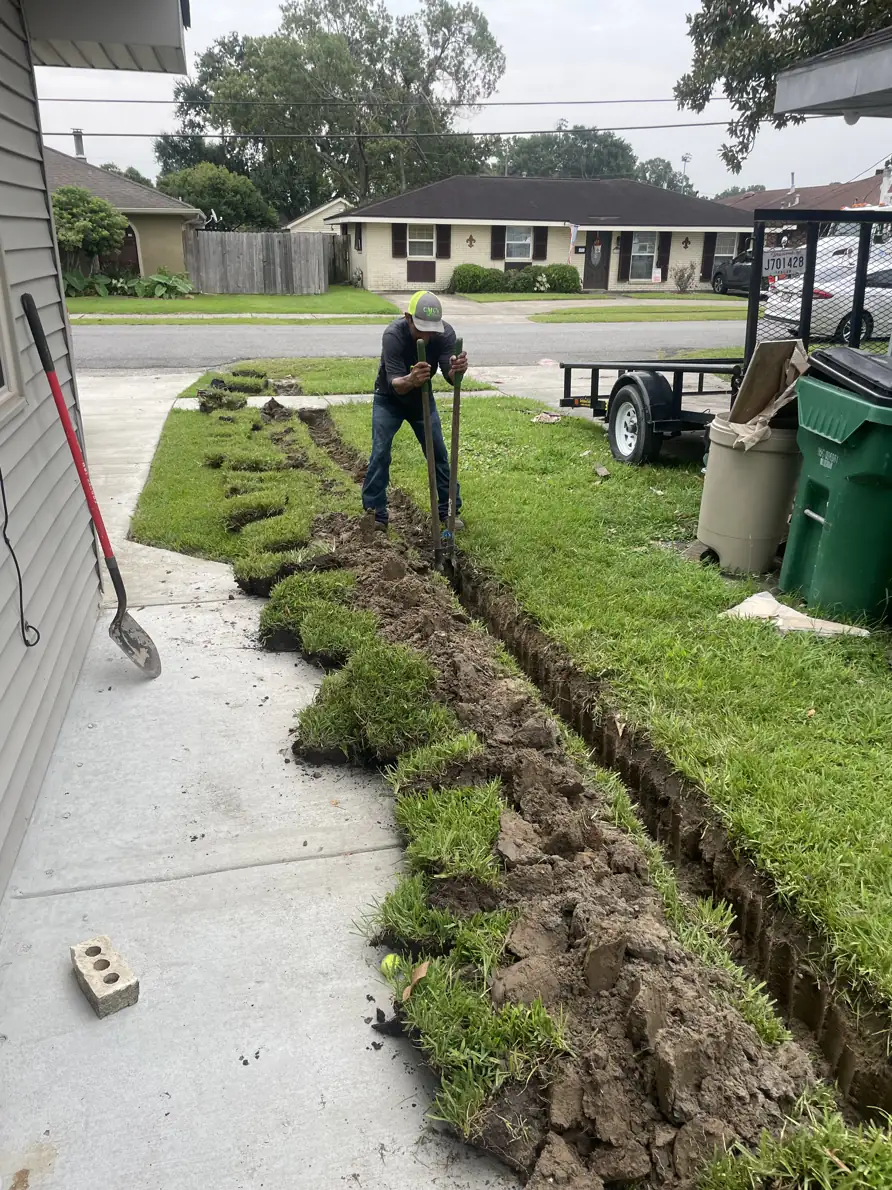
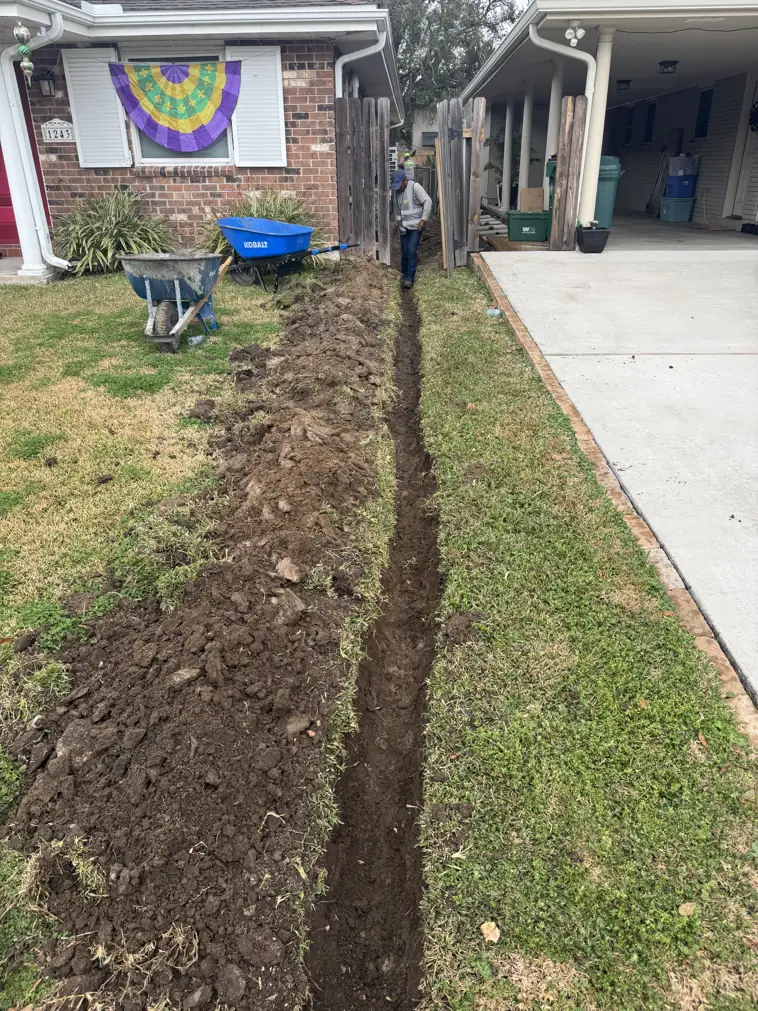
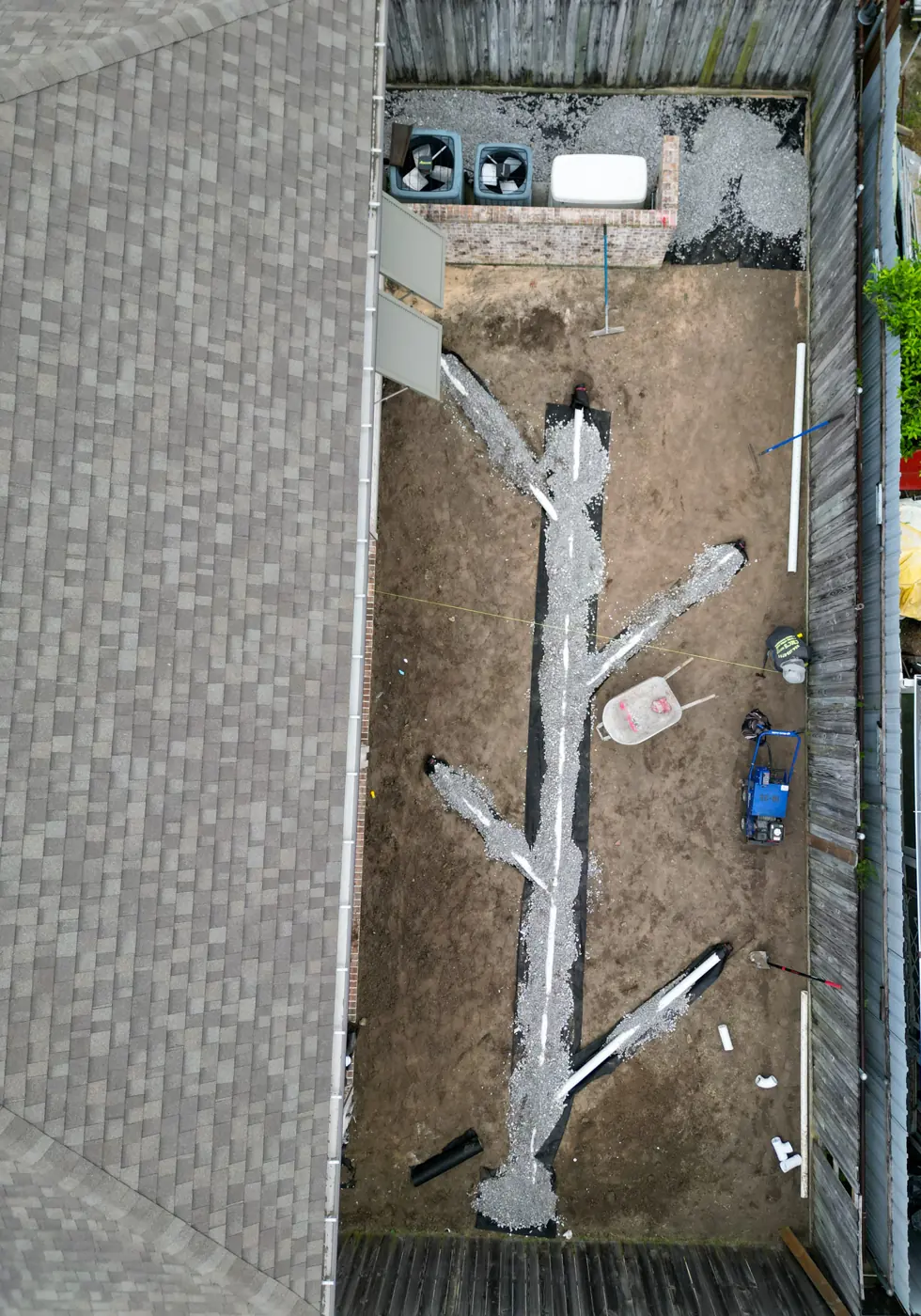
A French drain is a gravel trench wrapped in fabric, with a perforated pipe that picks up water along its length and carries it to an outlet. It works well along a fence line or in the narrow strip between two houses. Its weak point in this area is the outlet: on a flat lot, the nearest lower ground may be 60 or 80 feet away at the street.
A catch basin is a grated box set at the lowest spot in the yard with solid pipe running out of it, the right tool when water gathers in one corner. A channel drain is a narrow grated trough set into concrete or pavers that stops water crossing a driveway before it reaches the garage.
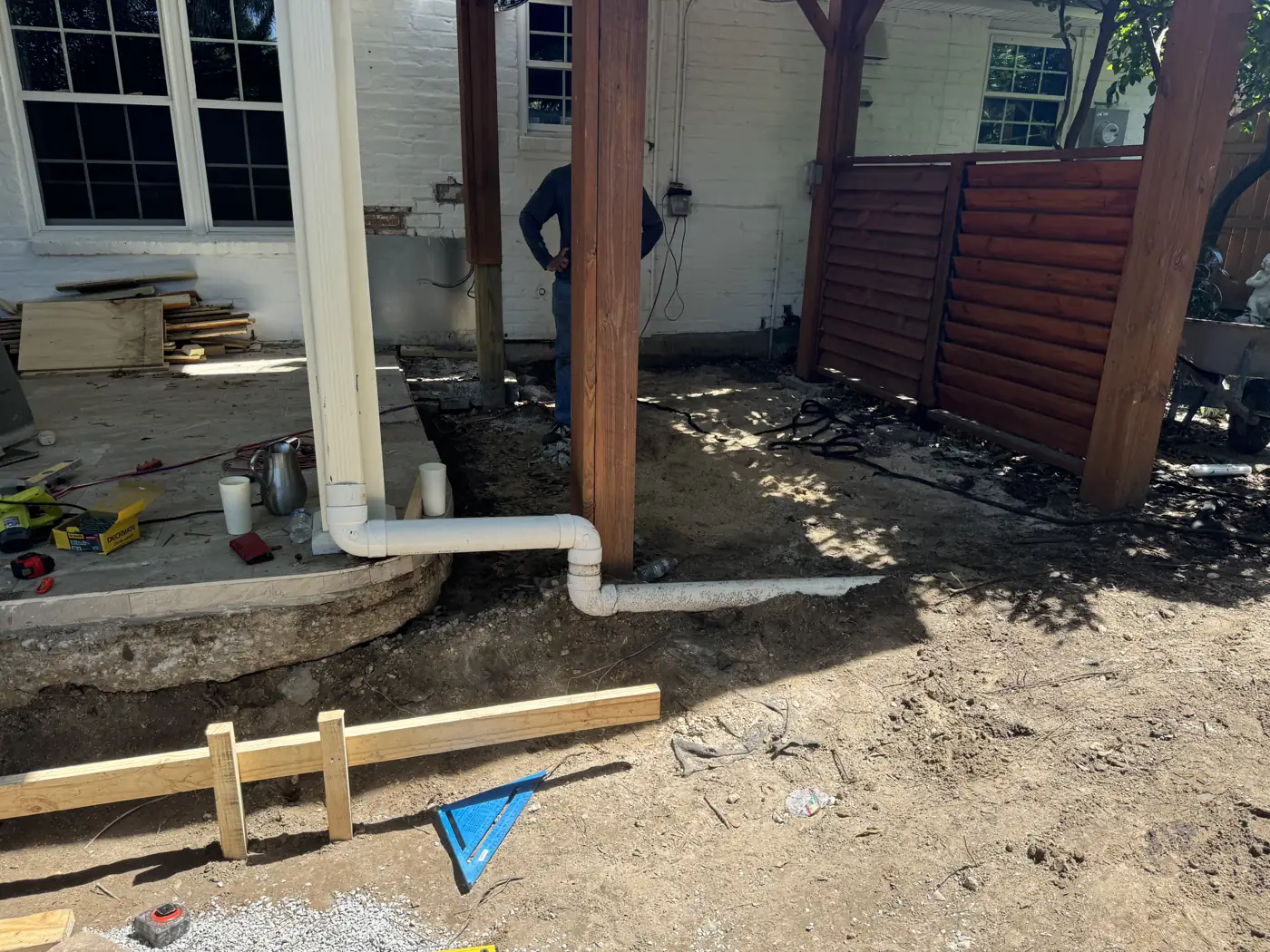
Downspout extensions are the cheapest fix and solve more than people expect. A plastic extension that carries roof water 4 to 6 feet from the house helps right away. The cleaner, permanent version buries 4 inch solid pipe from each downspout to a pop-up emitter or a catch basin line.
A pop-up emitter caps the end of a buried pipe. It opens when water pushes up and drops closed again to keep grass clippings out. The pipe needs at least 1/8 inch of fall per foot to reach it, which on a flat lot can mean running it all the way to the curb.
Dry wells struggle here. A dry well is a buried gravel pit or plastic tank that holds water and lets it seep into the ground. In places with sandy soil and a deep water table they work well. In Metairie and Kenner, the water table is often only a couple of feet down after a wet stretch, so the dry well is already full when the storm arrives. We rarely recommend one.
A sump pit and pump is the fallback when the lot has no lower ground at all. The pit collects the water and a pump pushes it to the street. It is the last resort because it needs power, and power goes out in hurricane season, so add a battery backup if you go this route.
How much does yard drainage cost in Metairie?
HomeAdvisor's national averages put a yard drainage system at $2,145 to $7,162, with a typical cost of about $4,620. A shallow yard French drain runs $10 to $35 per linear foot according to HomeGuide, and leveling a yard averages $500 to $5,000. A Metairie price depends on the length of pipe, the soil, access to the yard and where the water can discharge.
Those figures come from three national guides: HomeAdvisor's yard drainage cost guide, HomeGuide's French drain cost guide and HomeGuide's yard leveling cost guide. They are installed prices across the US, not CMC quotes.
HomeGuide puts fill dirt at $5 to $25 per cubic yard. Adding 4 inches of soil across a 1,000 square foot backyard takes about 12 cubic yards, so the labor, and getting it through a narrow side gate, usually costs more than the dirt itself. Burying two downspouts and regrading along the slab often costs less than a 100 foot French drain and handles more of the water.
Install times vary with the fix. Burying downspout lines to a pop-up emitter usually takes one day. A yard French drain or catch basin line of 50 to 100 feet is typically a one to three day job, depending on how much sod has to come up and how much concrete has to be cut. Regrading a backyard takes two to four days, plus time for new sod to root. Summer rain can delay any of it.
If water is sitting against your slab after every storm, we will walk the yard, mark where the water collects and give you a free estimate for grading, drains or both. We work in Metairie, Kenner, River Ridge and across Jefferson Parish.
What should you do before calling a drainage contractor?
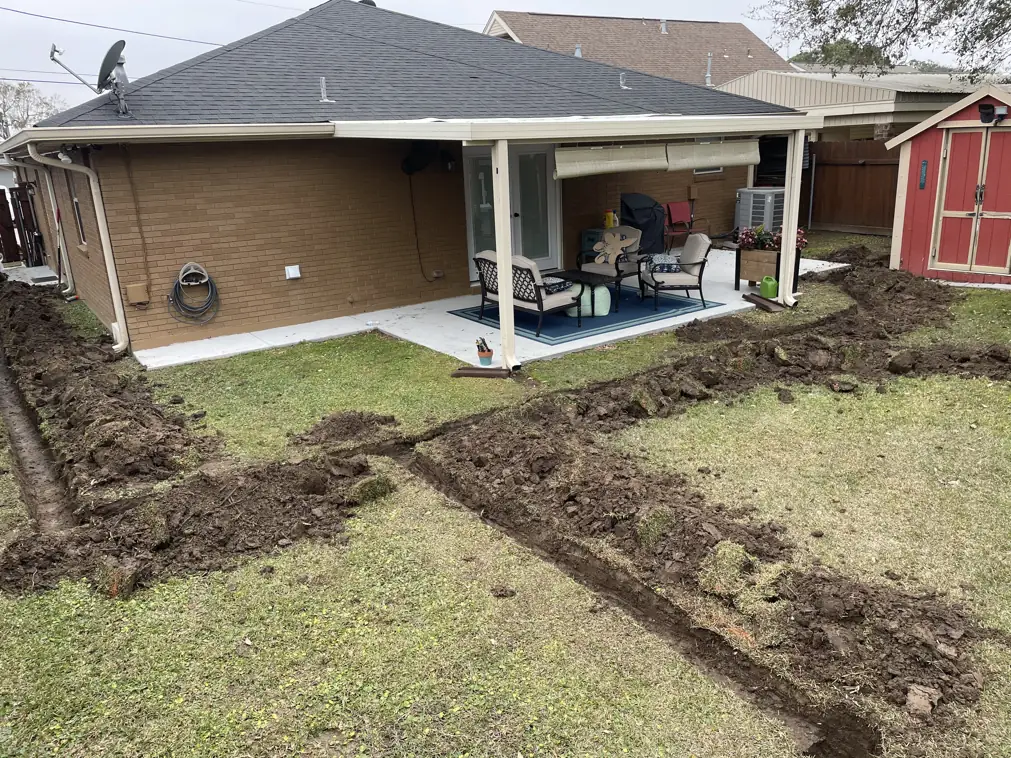
Before you call anyone, photograph the yard during and after two or three rains, write down how many hours the water stays, make sure the gutters and downspouts are clear, and clean out any yard drains you already have. Those four steps sometimes fix the problem outright, and they always make the estimate faster and more accurate.
Clogged gutters are behind a lot of flooded flower beds. A gutter that overflows drops a sheet of water straight down along the house. Clean them out and run a hose through each downspout. If a neighbor's new patio, pool or fill job happened recently, make a note of it, because drainage trouble often shows up the season after.
If you have an old yard drain, lift the grate. A shop vac and a hose can clear out sand, but a crushed pipe or one full of roots has to be dug up and replaced.
Do artificial turf or pavers help with drainage?
Artificial turf helps when it goes in over a compacted gravel base with the right slope, because the backing is perforated and rain passes through quickly. Pavers on a gravel base drain better than a poured slab, and permeable pavers let water through the joints. Neither one fixes a yard that slopes toward the house.
Turf suits the shady, soggy patch where St. Augustine keeps dying, as long as the base is graded toward a drain or swale. Our artificial turf installation in Metairie includes that base prep.
Pavers need the same planning. A patio has to pitch away from the house about 1/8 inch per foot, and the water running off it needs somewhere to go, often a channel drain or catch basin at the low edge. If you are pricing a patio anyway, plan the drain as part of the same project, because adding it later means pulling up pavers.
Who do I call about a flooded street or clogged street drain?
Street drains and canals are the government's responsibility, not the homeowner's. In Kenner, the city's Drainage Division handles subsurface drains, and Public Works takes calls at 504-468-7515. Canals and pump stations across the parish are under the Jefferson Parish Drainage Department, at 504-736-6753 during working hours and 504-736-6006 after hours.
Those numbers come from the City of Kenner Drainage Division page, which says the division flushes pipes, clears debris and replaces drain lines inside city limits. Metairie is not an incorporated city, so street drain problems there go straight to Jefferson Parish.
A clogged street basin backs water up over the curb into a low front yard, and no work on your side of the property line fixes that. Report it and keep grass clippings out of the gutter. Yard drains tied into a flooded street will back up too until the pumps catch up.
Who installs yard drainage in Metairie, Kenner and River Ridge?
CMC's Services installs yard drainage, French drains, catch basins and regrading across Jefferson Parish, including Metairie, Kenner and River Ridge. We are licensed and insured, we handle permitting, and estimates are free. Our office is at 5245 York St in Metairie, open Monday to Saturday, 9:00 AM to 5:00 PM.
Each town has its own service page with local details, starting with our drainage services in Metairie. We also do the same work in Kenner and River Ridge.
Our process runs from consultation to design and planning, then construction, then a final walkthrough, often with a hose running so you can watch the water reach the outlet. If you would like to send photos of your standing water first, use the contact form and we will tell you what we see.
To get your yard draining before the next storm, send us photos of where the water sits or book a free on-site estimate at (504) 608-4272. CMC's Services is backed by 215+ 5-star Google reviews and has done outdoor work in Metairie, Kenner and River Ridge for more than 10 years.